Introduction: Meta Is Expanding Its AI Capabilities
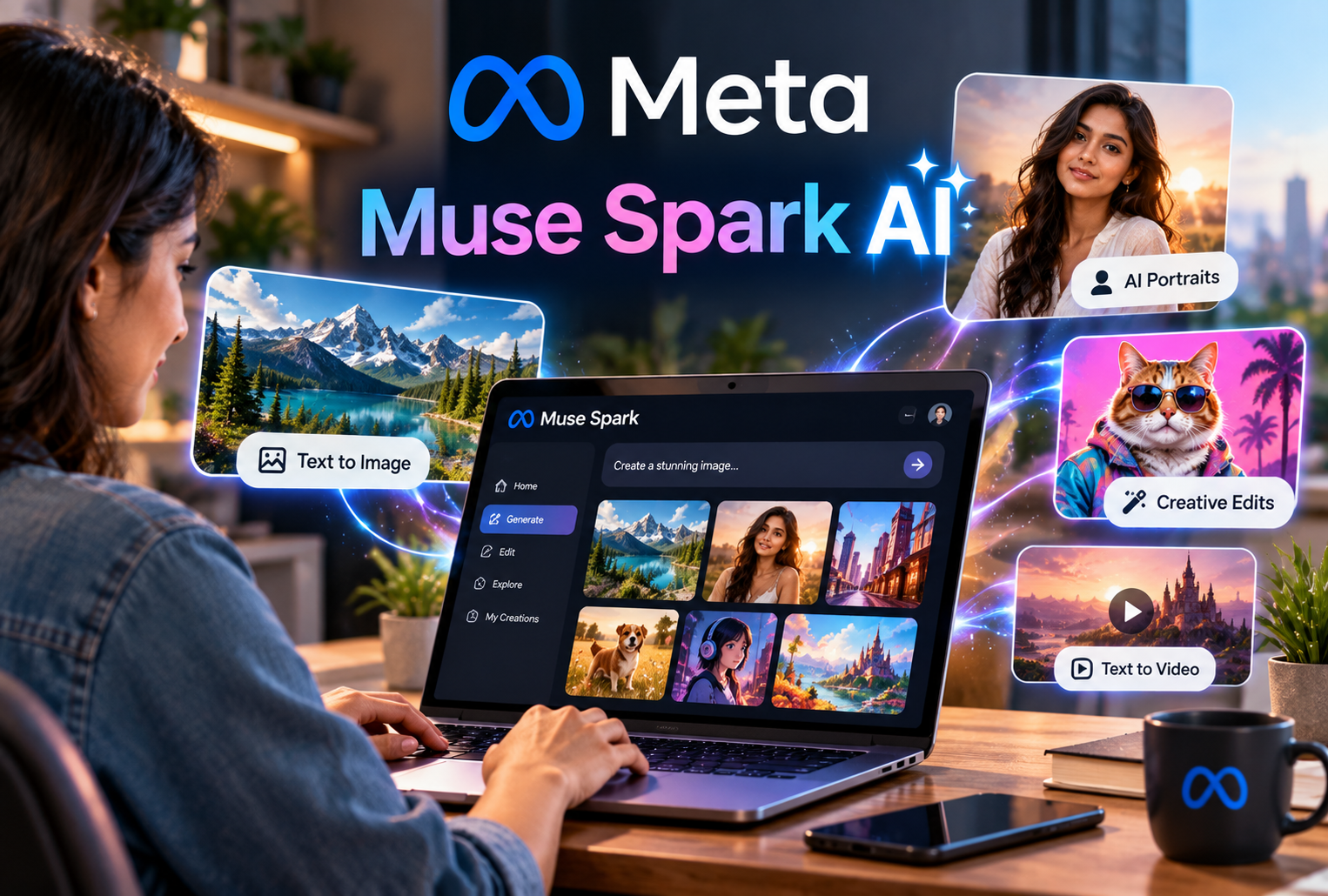
Meta has been developing a new family of artificial intelligence models under Meta Superintelligence Labs. One of its key releases is Muse Spark, a model designed to support reasoning, multimodal understanding and tool-assisted tasks.
The original Muse Spark announcement came in April 2026. Since then, Meta has introduced further versions, including Muse Spark 1.3 in September and Muse Spark Open in October 2026.
According to Meta's official Muse Spark announcement, the model was built to support tasks involving text, images, reasoning and tool use. The newer releases expand this direction with improvements for practical workflows and coding-related tasks.
The important point for users is that Muse Spark is not just a chatbot name. It belongs to a broader effort to build AI systems that can understand different kinds of information and help people complete more complex tasks.
What Is Meta Muse Spark AI?
Muse Spark is an AI model developed by Meta Superintelligence Labs. It is designed to interpret information, answer questions and support tasks that may require multiple reasoning steps.
A traditional chatbot may be useful for answering a straightforward question or drafting a short message. A more capable reasoning model aims to handle tasks that involve comparing information, analysing visual material, planning steps or using supported tools.
The exact capabilities depend on the model version and the product through which it is accessed. Features available in Meta AI, a developer API or a specialised coding tool may not be identical.
Users should therefore check the version and product documentation rather than assuming every Muse-branded service offers the same functions.
Key Features of Muse Spark
1. Multimodal Understanding
Multimodal AI can work with more than one type of input, such as text and images. This means a user may be able to ask questions about a supported visual input instead of describing every detail manually.
Possible applications include interpreting charts, understanding visual layouts and helping users reason about information shown in an image. The quality of the output depends on the image, the complexity of the task and the model's limitations.
For example, an AI system might help explain the main trend in a chart or identify elements in a diagram. Important results should still be checked, particularly when they influence financial, legal or safety decisions.
2. Reasoning and Multi-Step Tasks
Some questions require more than a single answer. They may involve breaking a problem into steps, comparing evidence and organising a response.
Meta has described Muse Spark as a reasoning model designed to handle complex questions. Later versions have placed additional emphasis on agentic tasks, where the system can use tools and sustain work across a longer sequence of actions.
However, the ability to plan a task does not mean that an AI system is always correct. Users should review important outputs and keep control over decisions that carry significant consequences.
3. Coding and Developer Workflows
AI models can assist developers with explaining code, drafting functions, finding likely errors and planning software changes. Meta's later Muse Spark releases have expanded capabilities in coding and tool-assisted workflows.
On October 15, 2026, Meta also announced Muse Spark Open, describing it as an open-weight model designed for coding and agentic work. Meta says it has 816 billion total parameters, with 42 billion active parameters, and a one-million-token context window.
These are technical specifications announced by Meta, not a guarantee that the model will outperform every alternative on every coding task. Actual performance depends on the benchmark, hardware, software configuration and task requirements.
4. Tool Use and Agentic Workflows
An AI agent can use supported tools to complete a sequence of steps rather than only generating text. Depending on its permissions and environment, it may help organise information, work with software or carry out parts of a workflow.
Meta's model updates reflect this wider move towards AI systems that can act with user direction. However, tool access should be carefully controlled. An agent that can edit files, access accounts or execute commands can also cause problems if it misunderstands a task.
For sensitive actions, users should review the plan and require confirmation before approving irreversible changes.
Where Can Users Access Muse Spark?
Availability depends on the specific version and product. Meta's original announcement introduced Muse Spark through Meta AI, while later releases expanded the model family and developer access.
Users can check the official Meta AI models page for current product information and the latest announcements. Developers should consult the relevant model documentation for API access, hardware requirements, supported inputs and usage restrictions.
A model being announced does not mean that every user can run it on every device. Open-weight models can still require substantial computing resources, and some hosted features may depend on account eligibility or regional availability.
How Is Muse Spark Different From a Basic Chatbot?
A basic chatbot primarily responds to prompts. A more advanced model may combine reasoning, multimodal input and tool use to support longer tasks.
For example, a user might ask an AI assistant to analyse a document, compare information and produce a structured summary. A tool-enabled system may also be able to perform specific actions in supported applications, if access has been granted.
The difference is not simply how natural the conversation sounds. It also involves the model's ability to use context, handle complex inputs, work with tools and complete a task reliably.
Even advanced systems can make mistakes, lose context or misunderstand instructions. Human review remains important.
Privacy, Accuracy and Security
Users should be careful when sharing confidential material with AI services. Personal documents, business records, customer information and private source code may require additional protection.
Before uploading information, review the provider's data policies and your organisation's rules. Businesses should also control who can access AI tools and whether those tools are permitted to connect to internal systems.
Another issue is reliability. AI-generated summaries may omit important details, while coding suggestions may contain bugs or insecure patterns. Test code before deploying it and verify factual claims against trustworthy sources.
What Could Muse Spark Mean for the AI Industry?
Muse Spark is part of the competition to build more capable general-purpose AI systems. Its evolution reflects several broader trends: multimodal reasoning, AI agents, developer tools and increasing interest in models that can support longer workflows.
The introduction of Muse Spark Open also highlights interest in models whose weights can be accessed by eligible developers, although hardware requirements and licensing conditions remain important.
Conclusion: Meta Muse Spark is an evolving family of AI models designed for reasoning, multimodal understanding and increasingly capable workflows. Its newer versions expand coding and agentic capabilities, but users should check the exact version, availability and technical requirements. As with other AI systems, privacy safeguards and human verification remain essential.