
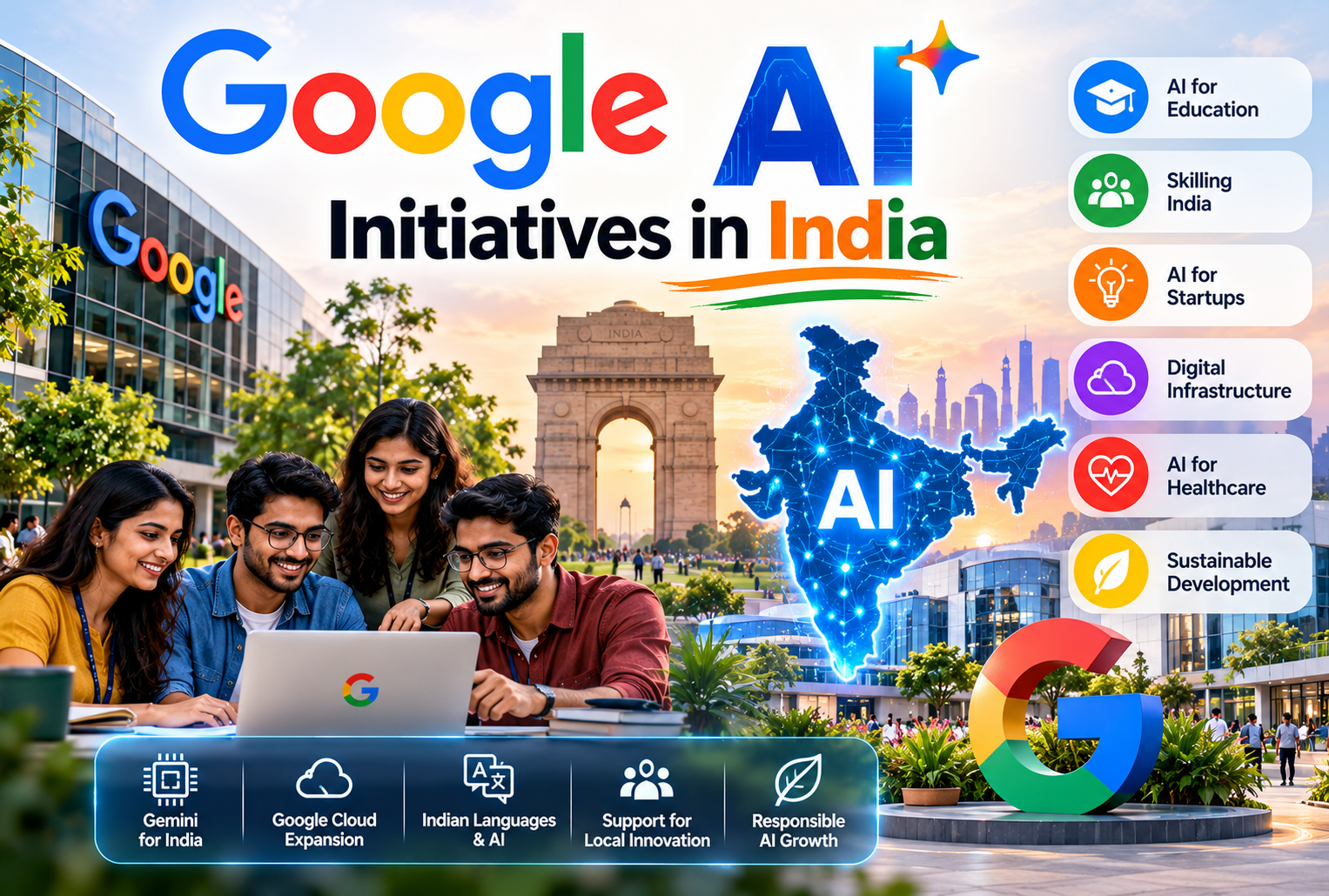
Google Expands Its Focus on Practical AI in India
Artificial intelligence is increasingly being explored as a tool for solving real-world problems. In India, potential uses range from helping researchers understand crops to supporting teachers and giving small businesses access to digital tools.
Google has announced a series of AI initiatives in India covering crop science, agriculture, education and economic inclusion. The announcement focuses on using AI through research partnerships, training programmes and tools intended to address practical needs.
According to The Times of India's report, the initiatives include agricultural research, AI training for educators and financial support aimed at small businesses. Google's own official announcement provides additional information about the programmes.
These developments reflect a wider effort to move AI beyond demonstrations and towards applications that people and organisations can use.
1. AI Could Help Advance Crop Science
Agriculture supports millions of livelihoods in India, making crop research an important area for innovation. Researchers need to understand plant genetics, crop resilience and other factors that influence food production.
One of Google's announced initiatives involves work on a sorghum genetic atlas. Sorghum is a crop grown in various parts of the world and can be important in food systems, particularly in regions where water availability and high temperatures create challenges.
AI-supported research tools may help scientists analyse complex biological information and identify patterns that would otherwise require significant time to examine.
However, AI is not a replacement for agricultural research, field trials or expert knowledge. Findings still need scientific validation before they can guide decisions about crop varieties and farming practices.
If these tools prove useful, they could help researchers investigate crop characteristics and contribute to longer-term work on food security.
2. Agricultural AI Tools for Developers
Another area of interest is making agricultural AI models available to developers. Access to research tools can help technology teams explore applications that respond to local needs.
For example, developers may investigate tools that help organise agricultural information, support research workflows or make technical resources easier to access. The value of any application will depend on the quality of its data, the needs of farmers and how effectively it works in real conditions.
AI in agriculture must also account for India's diversity. Different regions have different crops, languages, weather patterns, irrigation systems and farming practices. A tool that works in one location may not automatically be suitable elsewhere.
Local partnerships and practical testing will therefore be important if agricultural AI is to become useful beyond research environments.
3. AI Training and Support for Teachers
Education is another focus of Google's announced initiatives. Teachers are often expected to manage lesson planning, classroom activities, assessments and administrative responsibilities at the same time.
AI tools may help educators prepare teaching materials, generate practice questions, organise information or adapt explanations for different learning levels. Used carefully, these tools could give teachers more time to focus on students.
Google's announcement also describes an expansion of its educator training efforts through partnerships and online learning opportunities.
Still, AI in education should support teachers rather than replace their judgement. AI-generated information can contain errors, and learning materials must be checked for accuracy, age suitability and cultural relevance.
Schools also need to consider student privacy, responsible use and equal access to technology. The best results are likely to come when teachers receive practical training and remain responsible for classroom decisions.
4. Opportunities for Small Businesses
Small businesses often face challenges when trying to adopt new technologies. Limited budgets, a lack of specialised staff and the time required to learn unfamiliar tools can make digital transformation difficult.
AI may help businesses with everyday tasks such as drafting product descriptions, preparing customer communications, translating basic content and organising information. These uses can be helpful when they save time without compromising quality or customer trust.
The announced initiatives include a $15 million fund to support small businesses, as reported by The Times of India. Business owners should consult the official programme information for details about eligibility, application procedures and how the funding will be distributed.
AI tools are not guaranteed to increase sales or reduce costs in every situation. Businesses should identify a clear need, protect customer information and measure whether a tool actually improves their workflow.
5. Why Partnerships Matter for AI Development
Building a useful AI product requires more than developing a model. Researchers, educators, farmers, developers and businesses understand the problems that tools need to solve.
Partnerships can help identify those needs, test solutions in realistic environments and make improvements based on feedback.
India's wide range of languages and local conditions also means that AI development in India needs to consider accessibility. Tools should be evaluated for accuracy, usability and suitability for the people expected to use them.
Another important issue is responsible data use. Organisations developing or deploying AI need to consider privacy, security and the possible consequences of incorrect recommendations.
What Could These Initiatives Mean for India?
If implemented effectively, AI initiatives could help researchers explore complex scientific questions, support educators with preparation and provide small businesses with new digital capabilities.
The impact will depend on how accessible the programmes are, whether the tools address genuine needs and how well they perform outside controlled demonstrations.
It will also be important to evaluate results over time. Training numbers, funding announcements and new technologies are useful indicators of activity, but their long-term value depends on measurable outcomes.
Final Thoughts
Google's new AI initiatives in India highlight several areas where artificial intelligence may contribute to practical work, from crop science and education to small-business development.
The announcement is an important step in expanding AI-related partnerships, but the real test will be implementation. If the tools are reliable, accessible and developed around local needs, they could support useful work across different sectors.
For businesses, educators and researchers, the key is to view AI as a tool that can assist human expertise—not as a substitute for careful decisions, reliable evidence and real-world testing.