Gaming technology continues to evolve, giving players more ways to enjoy their favorite titles without necessarily investing in expensive equipment.
In 2026, two popular approaches are cloud gaming and traditional gaming PCs.
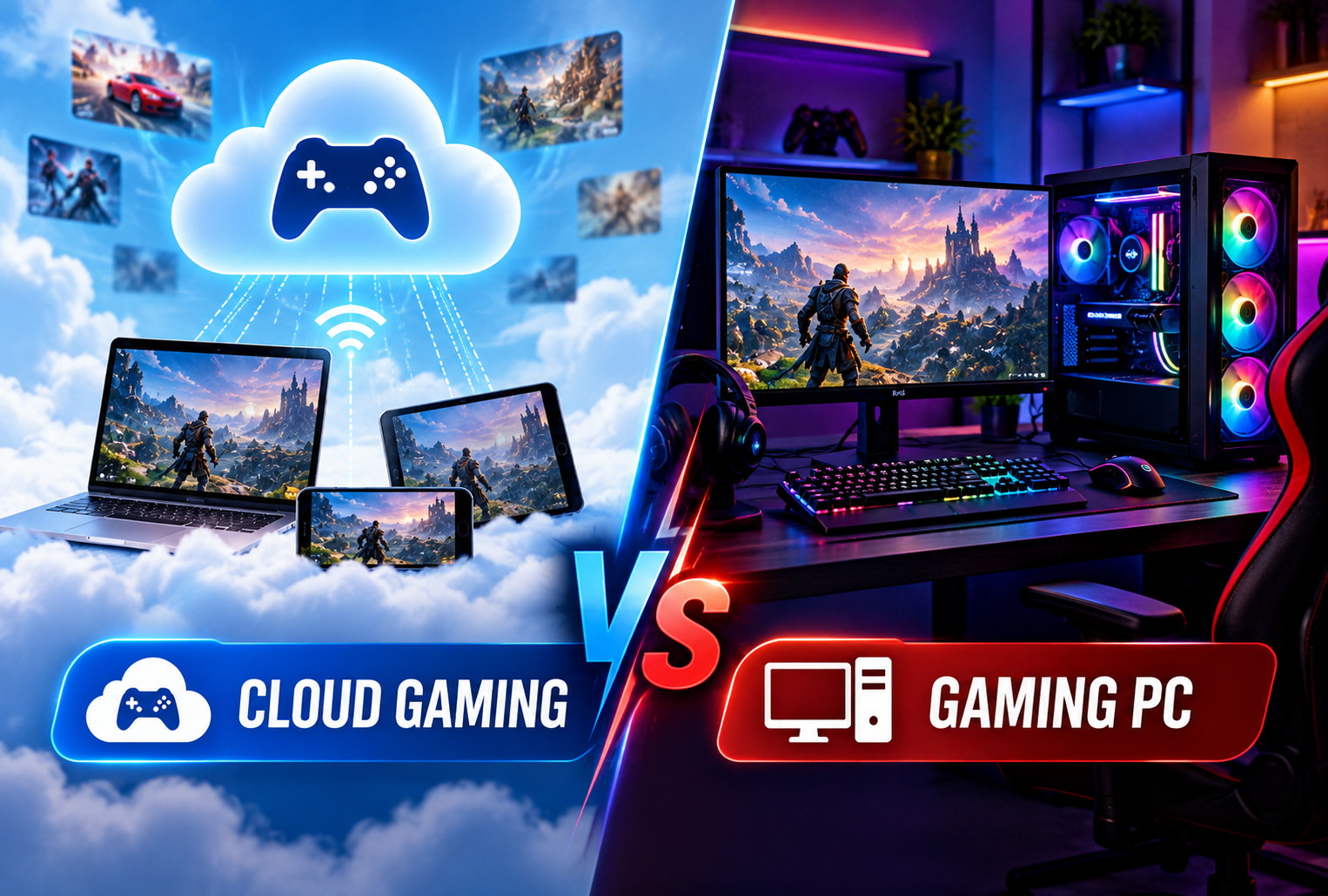
Cloud gaming allows players to stream games from remote servers, while gaming PCs run games directly on local hardware.
Both approaches offer advantages, but their costs, performance, flexibility, and internet requirements differ significantly.
Understanding cloud gaming vs gaming PC can help gamers select an option that matches their budget, gaming preferences, and long-term expectations.
What Is Cloud Gaming?
Cloud gaming is a technology that allows video games to run on remote servers instead of the player's own device.
The game processes graphics and gameplay on powerful computers located in data centers.
The resulting video is streamed to the player's screen, while controller or keyboard inputs are transmitted back to the server.
This means some demanding games can be played on compatible laptops, smartphones, tablets, or televisions without purchasing a high-performance computer.
Learn more about cloud gaming technology.
The biggest attraction is convenience, although the experience depends heavily on internet quality and service availability.
What Is a Gaming PC?
A gaming PC is a computer designed to run video games using its own processor, graphics card, memory, and storage.
Unlike cloud gaming, most gameplay processing happens directly on the computer.
Gaming PCs can be purchased as prebuilt systems or assembled using individual components.
Their performance depends on specifications such as the graphics processing unit, central processing unit, RAM, and cooling system.
You can explore the fundamentals of gaming computers on Wikipedia.
Although gaming PCs often require a larger initial investment, they provide greater control over hardware and software.
Cloud Gaming vs Gaming PC: Key Differences
|
Feature |
Cloud Gaming |
Gaming PC |
|---|---|---|
|
Initial investment |
Usually lower |
Usually higher |
|
Internet dependency |
High |
Lower for offline games |
|
Hardware upgrades |
Managed by provider |
Managed by owner |
|
Game availability |
Depends on service |
Depends on PC compatibility |
|
Graphics quality |
Depends on plan and connection |
Depends on hardware |
|
Portability |
Works across supported devices |
Desktop or laptop dependent |
|
Recurring costs |
Often subscription-based |
Optional subscriptions |
Neither option is automatically better for every player.
The ideal choice depends on how frequently someone plays, which games they prefer, and the quality of their internet connection.
Comparing Gaming Costs in 2026
Budget is one of the biggest considerations when comparing cloud gaming vs gaming PC.
Cloud Gaming Subscription Expenses
Many cloud gaming services use subscription plans that provide access to remote computing resources.
Some services also require players to purchase supported games separately.
For example, a hypothetical subscription costing $15 per month would total $180 annually.
Over three years, the subscription alone would cost $540, excluding games, internet charges, and possible price increases.
Cloud gaming may therefore be attractive to occasional players who do not want to purchase expensive equipment.
Gaming PC Ownership Expenses
The gaming PC cost depends on component quality, regional pricing, and performance requirements.
An entry-level system may be suitable for lightweight games, while demanding titles at high resolutions require more powerful components.
PC owners should also consider electricity, maintenance, accessories, and future upgrades.
However, a gaming PC can serve additional purposes, including education, programming, content creation, and video editing.
This broader usefulness may improve its overall value.
Cloud Gaming Performance and Internet Requirements
Reliable connectivity is essential for smooth game streaming.
Cloud gaming performance depends on several factors, including download speed, latency, network congestion, server distance, and video compression.
A fast internet connection does not always guarantee low input delay.
Latency measures the time taken for information to travel between the player and the remote server.
High latency can make fast-paced games feel less responsive.
For competitive shooters, fighting games, and rhythm-based titles, even relatively small delays may affect the experience.
Cloud gaming users should check their provider's recommended connection requirements and test the service before purchasing a long subscription.
Graphics Quality: Which Option Performs Better?
Modern cloud gaming platforms can provide impressive graphics through powerful remote hardware.
However, video streaming introduces compression, which may reduce image clarity in complex scenes.
A gaming PC renders graphics locally and can provide a more direct visual output.
Players with powerful graphics cards may enjoy high refresh rates, detailed textures, and customizable graphics settings.
That said, an older gaming PC may perform worse than a premium cloud gaming subscription.
The best comparison is between specific hardware configurations and service plans rather than between the technologies in general.
Gaming Hardware and Upgrade Flexibility
Traditional PCs provide substantial control over gaming hardware.
Desktop owners can often replace graphics cards, increase memory, add storage, or improve cooling.
These upgrades can extend a computer's useful life.
Cloud gaming subscribers generally do not manage the underlying hardware.
Instead, the provider maintains and upgrades its server infrastructure.
This eliminates many maintenance responsibilities, but players have limited control over which hardware configuration they receive.
Game Libraries and Ownership
Another important consideration in PC gaming vs cloud gaming is access to games.
Gaming PC owners can purchase titles from different digital stores, install compatible games, and maintain local game files.
Cloud gaming availability depends on provider licensing agreements, supported storefronts, and regional restrictions.
A game available through one platform today may not remain available indefinitely.
Players should verify that their favorite games are supported before subscribing.
Those who enjoy modifying games or using specialized software may prefer a traditional PC.
Best Affordable Gaming Options for Different Players
Choosing among affordable gaming options requires considering gaming habits rather than simply comparing monthly prices.
For Casual Gamers
Cloud gaming may be suitable for people who play occasionally and already own a compatible device.
It reduces the need for a major upfront purchase.
For Competitive Gamers
A gaming PC is generally preferable when low latency, high frame rates, and consistent responsiveness are priorities.
For Students
A gaming PC may offer greater versatility because it can also support assignments, programming, and creative work.
For Frequent Travelers
Cloud gaming can provide convenient access across compatible devices, provided reliable internet connectivity is available.
For Long-Term Enthusiasts
Players who enjoy upgrading components, experimenting with settings, and building game libraries may find PC ownership more satisfying.
Is Cloud Gaming the Future of Gaming?
Cloud gaming is likely to remain an important part of the gaming industry, particularly as streaming technology and network infrastructure improve.
However, traditional gaming PCs continue to offer advantages in performance control, offline access, customization, and compatibility.
Rather than replacing one another completely, these approaches may coexist.
Some gamers may even use both, playing locally at home and streaming supported titles while traveling.
Conclusion
The cloud gaming vs gaming PC decision ultimately depends on personal priorities.
Cloud gaming offers convenience, flexibility, and lower upfront hardware expenses.
Gaming PCs provide greater control, stronger offline capabilities, and the potential for high-performance gameplay.
Players should compare total costs over several years, consider their internet connection, and verify game availability before making a decision.
For occasional gamers, cloud streaming may provide excellent value. For enthusiasts seeking customization and consistent local performance, a gaming PC may be the better investment.